Not sure whether your hair is short, medium, long or extra long?
Our hair length chart is designed to help you confidently choose the right service when booking your appointment at Monika Kiss Hair & Beauty in Bristol.
We use clear body reference points rather than vague descriptions, so you know exactly where your hair sits and what to select when booking online.
What Is a Hair Length Chart?
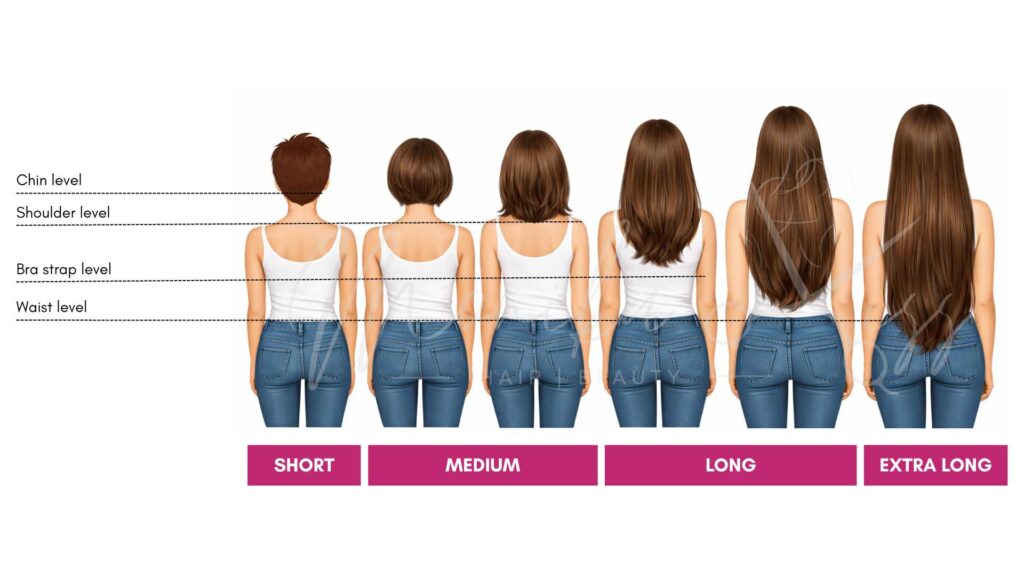
A hair length chart is a visual guide that shows how hair is categorised based on where it falls on the body.
At our salon, we measure hair from the back, not the front. This gives the most accurate representation of length and ensures correct pricing, appointment timing, and product usage.
Hair length typically falls into four categories:
- Short hair
- Medium hair
- Long hair
- Extra-long hair
If your hair sits between two categories, we always recommend selecting the longer option to allow enough time for your appointment.
Short Hair Length
Short hair usually sits above or around the chin level. This includes pixie cuts, cropped styles, and short bobs.
Short hair generally requires less product and less time for colouring or treatments. It is ideal for clients who love sharp, defined shapes or low-maintenance styles.
Medium Hair Length
Medium hair typically falls between chin and shoulder level or around shoulder length. This includes long bobs and classic shoulder-length cuts.
Medium hair is incredibly versatile. It works beautifully for layering, soft waves, balayage, and highlights. Most clients fall into this category.
Long Hair Length
Long hair falls below shoulder level or around bra strap level. Longer hair often requires more product and more detailed application for colour services such as balayage or full head highlights.
If your hair sits below your shoulders, you will usually fall into the long hair category when booking.
Extra Long Hair Length
Extra-long hair extends below bra strap level, or towards waist level or beyond
Extra-long hair requires additional time, sectioning, and product, particularly for colour corrections, lightening services, or smoothing treatments such as Nanoplastia or Keratin.
Selecting the correct length ensures we can deliver the high standard of finish your hair deserves.
How to Measure Your Hair Length Correctly
To use our hair length chart accurately:
- Stand naturally and look at your hair from the back.
- Measure your hair when it is dry and worn in its natural state.
- Identify where the longest layer falls against your body.
Do not measure from the front, as face-framing layers can make hair appear shorter than it actually is.
Why Hair Length Affects Pricing
You might wonder why we price services based on hair length.
Longer hair requires:
- More colour product
- More treatment product
- Longer application time
- Additional styling time
Transparent pricing ensures fairness for every client and allows us to maintain the high quality of products we use.
Our team has over a decade of hands on experience working with every hair length and texture. We carefully assess your hair during consultation to ensure you receive the right service for your needs.
Unsure Which Hair Length You Are?
We completely understand that it can feel confusing.
If you are between lengths or unsure how to categorise your hair, you can:
- Choose the longer option when booking
- Add a note to your booking
- Contact us for advice
We are always happy to guide you.
At Monika Kiss Hair & Beauty, we believe informed clients feel more confident. Our goal is to make your booking experience simple, transparent, and stress-free from the very beginning.
Frequently Asked Questions About Hair Length
Is shoulder-length hair considered long?
In most professional salons, shoulder-length hair is classified as medium rather than long.
Does hair thickness affect the length category?
Thickness does not change the length category, but it may affect timing. Very thick hair can require additional time even if it is medium length.
What if I book the wrong hair length?
Do not worry. We will assess your hair during the consultation and adjust if needed. Choosing the longer option helps avoid time constraints.